

Among the Clouds
A Journey Through Sri Lanka's Hill Country — From Kandy to Ella on the World's Most Scenic Train

The train leaves Kandy at seven in the morning and it does not hurry. It has no interest in hurrying. It climbs instead — slowly, deliberately, with the considered patience of something that knows the reward justifies the pace. Outside the open door, Sri Lanka unfolds in layers: the red-earth suburbs of Kandy giving way to forests, forests giving way to tea, tea giving way to cloud. By the time you reach Nanu Oya, five hours later, you are no longer in the same country you left.
Kandy: Before the Climb Begins
There is a particular quality of morning light in Kandy that has something to do with the lake and something to do with the hills and everything to do with the relationship between the two. The water holds the mist longer than it should, releasing it in slow columns that drift across the surface and dissolve against the treeline. By seven o'clock the town is already moving — tuk-tuks navigating the ring road with cheerful aggression, vendors setting up along the lakefront, the smell of wood smoke and roti and something sweet from the bakeries on Dalada Veediya.
We had spent two nights in Kandy, which is the right amount. Long enough to visit the Temple of the Tooth Relic in the early morning, when the crowds are thin and the smell of incense and fresh flowers is overwhelming in the best possible way. Long enough to walk the lake road at dusk, when the temple's cream walls turn amber in the last light and the bats begin their evening commute over the water. Long enough to understand why the Kandyan kings chose this bowl of hills as their final stronghold — it is a city that rewards those who stay still in it, and punishes those who rush through.
The train station at Kandy is a handsome colonial building in the town's centre, unremarkable until you understand what it is the beginning of. We were on the platform at 6:40, bags lighter than they probably should have been, with two oranges and a thermos of tea. The train arrived exactly on time, which felt like a good omen.
The Temple of the Tooth at dawn, before the crowds arrive — that is Kandy as it wants to be experienced. The mist on the lake. The smell of jasmine and incense. The priests preparing the morning puja in the half-light.

The Train: The Slower the Better
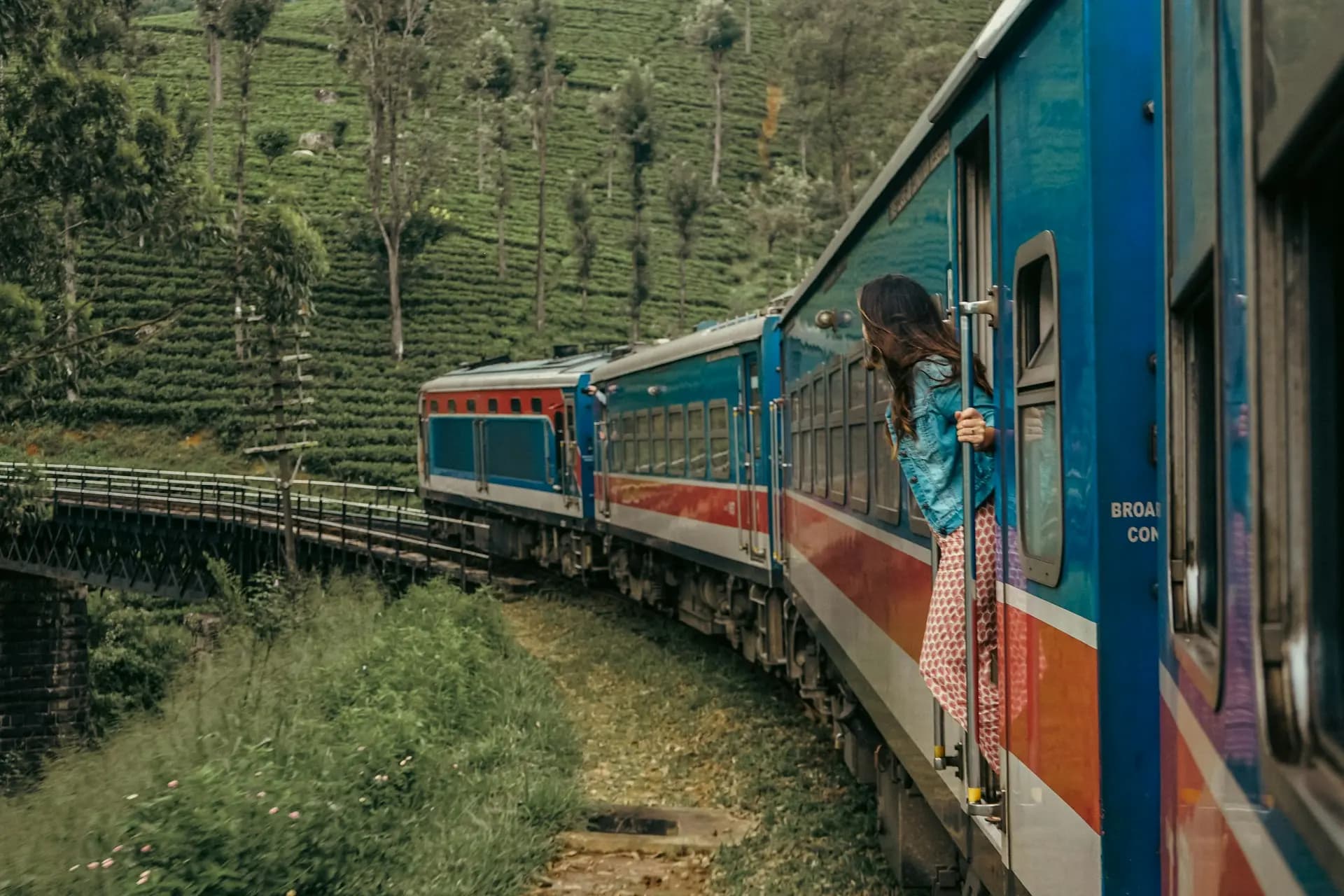
The train leaves Kandy at seven in the morning and it does not hurry. It has no interest in hurrying. It climbs instead — slowly, deliberately, with the considered patience of something that knows the reward justifies the pace. Outside the open door, Sri Lanka unfolds in layers: the red-earth suburbs of Kandy giving way to forests, forests giving way to tea, tea giving way to cloud. By the time you reach Nanu Oya, five hours later, you are no longer in the same country you left.
The Kandy–Ella train is consistently named among the most beautiful train journeys in the world, and it earns that designation without argument. What the rankings fail to convey is the quality of the experience from the inside: the feel of the carriages — old, unhurried, faintly colonial — the sound of the wheels on the track changing pitch as the gradient steepens, the particular pleasure of standing in the open doorway as the train rounds a curve and you can see the full length of it ahead, curling into the green like a sentence searching for its conclusion.
The scenery through Hatton and Adams Peak country is dramatic in a way that ordinary landscape is not. The valleys drop away with a sudden violence that makes you step back from the doorway. The tea estates cover everything — every hill, every slope, every platform and terrace that human effort has cut into the hillside over the last hundred and fifty years. Women in bright saris move along the rows with their picking bags, their motion economical and precise, unchanged in its essentials since the British planters first brought the tea to these hills in the 1860s.
We bought string hoppers from a vendor who appeared at Hatton with a basket balanced on her head and coins ready for change. We ate them with a coconut sambol that was by any reasonable standard one of the finer breakfasts available anywhere on earth. The train moved on through the mist.
Stand in the open doorway as the train rounds a bend above Hatton and the valley drops a thousand feet below the tracks, and you understand why people come from every corner of the world to sit in these carriages. It is not comfortable travel. It is extraordinary travel.
Nuwara Eliya: The Little England That Never Left
The British built Nuwara Eliya as a retreat from the heat of Colombo and Kandy, and they built it with a homesickness so acute it became architecture. The result is one of Sri Lanka's most peculiar and fascinating towns: a hill station at 1,868 metres above sea level where Tudor-style manor houses sit behind English cottage gardens, where the colonial-era Hill Club still requires a jacket in its dining room, and where the temperature drops enough at night that beds come with extra blankets and fireplaces are not decorative.
We arrived in the early afternoon, having descended from the train at Nanu Oya and taken a tuk-tuk up the winding road into town. The air hit us immediately — cool, clean, carrying the mineral edge of altitude and the green smell of the surrounding tea estates. After weeks in coastal Sri Lanka, it felt like stepping into a different climate zone entirely, which is precisely what it is.
The market street is chaotic and wonderful: vegetable stalls piled with produce that thrives at altitude — leeks, cabbages, strawberries, carrots in colours you don't find at sea level. The strawberries are remarkable — small, intensely flavoured, sold by the packet for almost nothing — and we bought three packets and ate them walking. The local strawberry farms, spread across the hillsides around town, supply not just the market but several of Sri Lanka's high-end hotels.
The Gregory Lake in the afternoon, when the mist is clearing and the light is horizontal and gold, is one of those unpretentious pleasures that travel occasionally produces: a walk around a lake, a hired paddleboat, the distant sound of the racecourse, a slow hour with nothing demanded of you. Nuwara Eliya rewards this kind of aimless engagement more than it rewards sightseeing. The best thing to do here is simply inhabit it for a day, at the pace the altitude imposes.
The strawberries cost almost nothing. They tasted like what strawberries are supposed to taste like before distance and refrigeration took that quality away. We ate them on a bench by Gregory Lake and agreed it was the best three hundred rupees we had ever spent.

The Tea Country: A Hundred and Fifty Years of Green
To travel through Sri Lanka's Central Highlands without understanding tea is to miss the story that underlies everything you are looking at. The hills were not always green in this particular way. Before the British planters arrived in the 1860s — many of them displaced coffee growers fleeing the leaf rust that had devastated the lower-altitude plantations — this was forest. The transformation of those hills into the most productive tea-growing region in Asia is one of the most dramatic landscape alterations in the colonial period, and it is still ongoing.
The tea cycle never stops. In the high country around Nuwara Eliya, Dimbula, and Uva, plucking happens year-round, the bushes trimmed to waist height along their terraces, the tender two-leaves-and-a-bud that constitutes the best-quality harvest perpetually regenerating. A skilled plucker harvests between fifteen and thirty kilos of fresh leaf per day — which will reduce to three to six kilos of finished tea through withering, rolling, oxidation, and drying.
We visited a working estate outside Nuwara Eliya on our second morning, guided by the estate manager who had worked there for thirty years and whose knowledge of the terroir — that French concept applied here with complete authority — was exhaustive. He walked us through the factory, explaining each stage of the process with the precision of someone who has explained it thousands of times and has never found it any less interesting. The smell inside a working tea factory — warm, complex, botanical, slightly sweet — is one of those sensory experiences that lodges somewhere permanent and surfaces later, unexpectedly, always with pleasure.
The tea factory smells like nothing else on earth — warm, complex, slightly sweet, a little earthy. The manager told us that the aroma changes through the day as different batches move through the rolling and oxidation stages. He could tell the time of day by the smell alone, he said. We believed him.

Knuckles Mountain Range: The Mist and the Wild
If the tea country is Sri Lanka's managed landscape at its most spectacular, the Knuckles Mountain Range is its wild counterpart — a UNESCO World Heritage Site of extraordinary biodiversity tucked into the eastern edge of the Central Highlands, named for the series of peaks that, seen from the lowlands on a clear day, resemble the knuckles of a clenched fist.
We spent a day walking the lower Knuckles trails, guided by a young man from the village at the trailhead whose pace was calibrated, mercifully, to ours rather than his own capacity. The terrain transitions rapidly — dry scrub gives way to cloud forest within an hour's walking, the temperature dropping perceptibly as you gain altitude and the canopy closes overhead. Tree ferns grow to improbable heights. Mosses cover everything. The bird calls are constant and overlapping, a dense texture of sound that the guide could parse into individual species with a facility that seemed almost supernatural.
The Knuckles is home to over thirty endemic species of flora and a dense bird population including the Sri Lanka Whistling Thrush, the Dull-blue Flycatcher, and the elusive Sri Lanka Spurfowl, heard far more often than seen. Leopards and the endemic Purple-faced Langur are present. Wild boar are common. We encountered a troop of Toque Macaques on the ridge trail — small, alert, deeply unimpressed by our presence — who watched us pass from the branches with the expression of creatures in possession of information we did not have.
The Knuckles clouds move fast. One moment the valley below is visible in full detail — the paddy terraces, the river, the village smoke — and the next it is gone, replaced by a whiteness so complete it feels like the world has contracted to the path under your feet and the ten metres of green on either side. It is not frightening. It is clarifying.

Kithulgala: The River That Runs White
Kithulgala sits at the western edge of the hill country, where the Kelani River comes down fast and cold from its headwaters near Hatton. The town is small — a scattering of guesthouses, a handful of rafting operators, a bridge that shakes when the lorries cross it. The air here is heavier than on the heights, thick with the moisture of the surrounding rainforest, and the sound of the river is constant, present in every room of every building in town.
White-water rafting on the Kelani is the activity that most visitors come for, and it delivers without reservation. The Grade 3–4 rapids through the Kithulgala stretch are technical enough to be genuinely exciting and forgiving enough that first-timers emerge exhilarated rather than traumatised. Our guide briefed us with the crisp authority of someone who has paddled this water hundreds of times and respects it completely — which is the quality you want in a rafting guide. The river was high from recent rain, the brown-green water moving with the particular urgency of a current that has come a long way and still has further to go.
But Kithulgala offers more than adrenaline. The rainforest around town is some of the finest birdwatching habitat in Sri Lanka — the area around the Kelani River is well known among ornithologists for Sri Lanka endemic species including the Serendib Scops Owl, found here before it was described as a new species in 2001. Guided nature walks through the riverside forest in the early morning, before the heat builds, are among the most rewarding wildlife experiences the island offers.
The rapid called 'Victoria' drops three metres in the span of twenty metres and does so without any interest in your feelings about it. You enter it paddling and exit it laughing, because there is no other appropriate response to that amount of water moving that quickly underneath a raft full of people who are not, ultimately, in control of anything.

Ella: The Town That Wears Its Views Like a Coat
Ella has been discovered. This is both its challenge and its enduring appeal. The challenge: on any given day in December or March, the town's single main street is busy with travellers from every country, the cafes are full, the guest houses charge more than they did five years ago, and the famous Ella Rock hike has the gentle, well-worn feel of a path that many feet have preceded yours along.
The enduring appeal: none of this has diminished the view from Ella Gap, which is one of the great views in Asia. Stand at the gap in the late afternoon and look south, and the hill country drops away beneath you in a series of receding ridges — green, blue, haze — extending to the coastal plain which is invisible but implied, somewhere beyond the furthest edge of what you can see. The scale of it is difficult to process. It is not a view you take in. It is a view that takes you in.
Ella Rock is accessible and rewards the effort with a summit plateau that sits above the clouds on good mornings. The nine-arch bridge at Demodara, a short walk or tuk-tuk ride from town, is one of the most photographed structures in Sri Lanka — a colonial-era railway viaduct of elegant proportions, arching over a valley of tea, best experienced in the early morning when the mist is still in the valley and the train, if you time it right, crosses accompanied by its own small cloud of steam.
We spent three nights in Ella, which felt like the right amount and slightly not quite enough. We ate at small places on the main street where the rice and curry was excellent and the wifi was unreliable, which felt like the correct balance. We hiked in the mornings and sat on guest house terraces in the afternoons and watched the clouds perform their daily theatre over the Gap. It is the kind of town that makes you understand why people arrive meaning to stay two nights and leave three weeks later.
The light at Ella Gap in the late afternoon — when the shadows lengthen and the ridges turn from green to blue to grey in sequence — is the kind of light that makes you very quiet and very aware that there is something about being alive in a particular place at a particular moment that no photograph has ever successfully conveyed.

Ella Rock
The route to Ella Rock starts modestly — follow the railway track from town, cross at the appropriate point, pick up the trail marker — and quickly becomes something more demanding. The ascent through rubber and tea is steep in places, the path narrowing between the bushes in a way that makes you choose your footholds. The summit, when you reach it, is a rocky plateau that juts out above the surrounding terrain, offering a 270-degree panorama that includes, on a clear morning, the full sweep of the southern hill country and, far below, the glint of the Kirindi Oya making its way toward the coastal plain.
The summit is not a solitary experience — you will share it with other hikers — but the walk up and down through the estate is quiet and pleasant and rewards early starts. Leave town by six if you want the summit to yourself for even twenty minutes.
The Nine Arch Bridge
The Demodara Nine Arch Bridge was completed in 1921, built without steel due to wartime shortages using only brick, stone, and cement. It spans a forested valley between two tunnels with an elegance that seems unlikely for a purely functional structure, and it has become one of the most recognised images of Sri Lanka.
The best viewing point is from the tea estate below, reached by a short walk from Ella town or a quick tuk-tuk ride. The train crosses several times daily — check the schedule with your guesthouse for the morning and afternoon timings. There is something genuinely affecting about watching a train cross a structure that is over a century old, still doing precisely what it was built to do, with no apparent intention of stopping.

Hill Country on a Plate
The food of the hill country is shaped by altitude and agriculture. The vegetables are different here — fresher, crisper, grown in a climate that produces leeks, carrots, beans, and potatoes of an exceptional quality. A hill-country rice and curry arrives with half a dozen vegetable curries side by side: a beetroot curry that is nothing like anything you associate with beetroot, a green bean tempered with mustard seeds and curry leaves, a potato dish coloured yellow with turmeric and cooled slightly with coconut milk. The flavours are clean and layered and generous.
Kottu roti is ubiquitous and excellent — the sound of it being prepared, the rhythmic metal-on-griddle chopping that carries down any street where it is being made, is one of the defining sounds of Sri Lanka. In Ella, the small restaurants on the main street make good kottu for very little money, and eating it at a plastic table on a terrace while the evening cloud rolls in over the Gap is one of the quieter pleasures of hill-country travel.
In Nuwara Eliya, do not leave without visiting a tea room for a proper high-tea service — finger sandwiches, scones with jam and clotted cream, a pot of single-estate Ceylon tea that costs almost nothing and tastes extraordinary at the altitude where it was grown, which is the altitude where you are drinking it. The British left many legacies in these hills; this one is entirely worth keeping.
A proper high tea in Nuwara Eliya — scones, jam, cream, a pot of single-estate Ceylon tea — costs almost nothing and tastes of everything the hill country is: precise, unhurried, high above the rest of the world.
The Road Down: What the Hill Country Does to You
We descended from Ella by bus, which is not the most comfortable way to leave the hill country but is possibly the most honest. The road winds down through rubber estates and banana groves, the temperature rising degree by degree as altitude gives way, the air thickening and warming around you as if the coast were pulling you back toward it.
The hill country does something particular to you that takes a few days on lower ground to identify. It slows you down — not physically, but in some internal register of pace. The altitude, the temperature, the tea-estate rhythms, the mist, the particular quality of light through cloud at 1,800 metres: all of it conspires to make urgency feel not just unnecessary but slightly absurd. You return from the hill country with a recalibrated understanding of what pace is appropriate for how you want to live.
The train from Kandy to Ella. The strawberries by Gregory Lake. The cloud at Knuckles closing in from three directions. The nine-arch bridge in the morning. The smell of the tea factory. The view from Ella Gap in the late afternoon light. These are the things that remain after the details blur, and they remain with a clarity that suggests they are not just memories but something more structural — part of the mental architecture of having been somewhere that was worth going to slowly.
You do not leave the hill country unchanged. Something in the pace of it — the mist, the altitude, the tea estates, the slow train — gets inside you and adjusts something. You do not know exactly what has been adjusted until you are back on the coast and moving too fast again.
Essential Travel Notes
- Getting There:Fly to Colombo, then train or van transfer to Kandy (2.5–3 hours). The Kandy–Ella train journey (6–7 hours) is itself a major highlight — book observation car seats in advance through Sri Lanka Railways.
- The Train:The No. 1005 Udarata Menike departs Kandy at 8:47 AM and arrives Ella approximately 3:30 PM. Observation car tickets must be booked in advance. Standard class is adequate and more social.
- Nuwara Eliya:Two nights minimum. Visit Gregory Lake, the tea estates, and the post office (a colonial gem). The Hill Club accepts non-resident dinner reservations — jacket required.
- Ella:Three nights recommended. Ella Rock hike (start before 7 AM), Nine Arch Bridge (check train times), and sunset watching at the Gap. Most guesthouses will help arrange tuk-tuks and guides.
- Knuckles Trekking:Day trips possible from Kandy or Matale. Guides are required and readily available. Best season January–April. Carry waterproofs — the weather changes fast.
- Kithulgala:Can be visited as a day trip from Kandy or as an overnight en route between Kandy and the coast. Rafting operators are well-established; go with a licensed operator.
- Best Time to Visit:January–April for clear skies and dry trails. The hill country has its own microclimate — expect mist and rain regardless of season, especially in Nuwara Eliya.
- Ideal Duration:Five to seven days minimum to cover Kandy, Nuwara Eliya, and Ella. Add a day for Kithulgala or a Knuckles day hike. Do not rush this part of Sri Lanka.
Ready to experience Kalpitiya?
Ruby Asia Travel & Tours can arrange private transfers, lagoon safaris, dolphin watching excursions, and tailor-made itineraries for the northwest coast.
Plan Your Trip